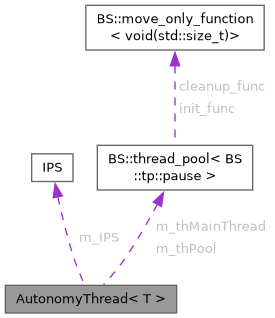
Interface class used to easily multithread a child class.
More...
#include <AutonomyThread.hpp>
|
| | AutonomyThread () |
| | Construct a new Autonomy Thread object.
|
| virtual | ~AutonomyThread () |
| | Destroy the Autonomy Thread object. If the parent object or main thread is destroyed or exited while this thread is still running, a race condition will occur. Stopping and joining the thread here insures that the main program can't exit if the user forgot to stop and join the thread.
|
| void | Start () |
| | When this method is called, it starts a new thread that runs the code within the ThreadedContinuousCode method. This is the users main code that will run the important and continuous code for the class.
|
| void | RequestStop () |
| | Signals threads to stop executing user code, terminate. DOES NOT JOIN. This method will not force the thread to exit, if the user code is not written properly and contains WHILE statement or any other long-executing or blocking code, then the thread will not exit until the next iteration.
|
| void | Join () |
| | Waits for thread to finish executing and then closes thread. This method will block the calling code until thread is finished.
|
| bool | Joinable () const |
| | Check if the code within the thread and all pools created by it are finished executing and the thread is ready to be closed.
|
| AutonomyThreadState | GetThreadState () const |
| | Accessor for the Threads State private member.
|
| IPS & | GetIPS () |
| | Accessor for the Frame I P S private member.
|
| void | SetMainThreadPriority (AutonomyThreadPriority ePriority) |
| | Set the OS priority for the main continuous thread.
|
| void | SetPoolThreadPriority (AutonomyThreadPriority ePriority) |
| | Set the OS priority for the highly parallelized pool threads.
|
|
| void | RunPool (const unsigned int nNumTasksToQueue, const unsigned int nNumThreads=2, const bool bForceStopCurrentThreads=false) |
| | When this method is called, it starts/adds tasks to a thread pool that runs nNumTasksToQueue copies of the code within the PooledLinearCode() method using nNumThreads number of threads. This is meant to be used as an internal utility of the child class to further improve parallelization. Default value for nNumThreads is 2.
|
| void | RunDetachedPool (const unsigned int nNumTasksToQueue, const unsigned int nNumThreads=2, const bool bForceStopCurrentThreads=false) |
| | When this method is called, it starts a thread pool full of threads that don't return std::futures (like a placeholder for the thread return type). This means the thread will not have a return type and there is no way to determine if the thread has finished other than calling the Join() method. Only use this if you want to 'set and forget'. It will be faster as it doesn't return futures. Runs PooledLinearCode() method code. This is meant to be used as an internal utility of the child class to further improve parallelization.
|
| template<typename N, typename F> |
| void | ParallelizeLoop (const int nNumThreads, const N tTotalIterations, F &&tLoopFunction) |
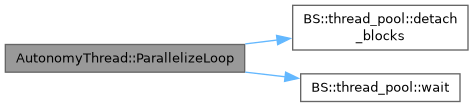
| | Given a ref-qualified looping function and an arbitrary number of iterations, this method will divide up the loop and run each section in a thread pool. This function must not return anything. This method will block until the loop has completed.
|
| void | ClearPoolQueue () |
| | Clears any tasks waiting to be ran in the queue, tasks currently running will remain running.
|
| void | JoinPool () |
| | Waits for pool to finish executing tasks. This method will block the calling code until thread is finished.
|
| bool | PoolJoinable () const |
| | Check if the internal pool threads are done executing code and the queue is empty.
|
| void | SetMainThreadIPSLimit (int nMaxIterationsPerSecond=0) |
| | Mutator for the Main Thread Max I P S private member.
|
| int | GetPoolNumOfThreads () |
| | Accessor for the Pool Num Of Threads private member.
|
| int | GetPoolQueueLength () |
| | Accessor for the Pool Queue Size private member.
|
| std::vector< T > | GetPoolResults () |
| | Accessor for the Pool Results private member. The action of getting results will destroy and remove them from this object. This method blocks if the thread is not finished, so no need to call JoinPool() before getting results.
|
| int | GetMainThreadMaxIPS () const |
| | Accessor for the Main Thread Max I P S private member.
|
|
| virtual void | ThreadedContinuousCode ()=0 |
| virtual T | PooledLinearCode ()=0 |
| void | RunThread (std::atomic_bool &bStopThread) |
| | This method is ran in a separate thread. It is a middleware between the class member thread and the user code that handles graceful stopping of user code. This method is intentionally designed to not return anything.
|
template<class T>
class AutonomyThread< T >
Interface class used to easily multithread a child class.
- Template Parameters
-
| T | - Variable return type of internal pooled code. |
- Author
- ClayJay3 (clayt.nosp@m.onra.nosp@m.ycowe.nosp@m.n@gm.nosp@m.ail.c.nosp@m.om)
- Date
- 2023-07-27
◆ AutonomyThreadPriority
| Enumerator |
|---|
| eLowest | |
| eLow | |
| eNormal | |
| eHigh | |
| eHighest | |
56 {
61
63 };
@ lowest
Definition BS_thread_pool.hpp:399
@ high
Definition BS_thread_pool.hpp:402
@ highest
Definition BS_thread_pool.hpp:403
@ low
Definition BS_thread_pool.hpp:400
@ normal
Definition BS_thread_pool.hpp:401
◆ AutonomyThreadState
| Enumerator |
|---|
| eStarting | |
| eRunning | |
| eStopping | |
| eStopped | |
46 {
47 eStarting,
48 eRunning,
49 eStopping,
50 eStopped
51 };
◆ AutonomyThread()
Construct a new Autonomy Thread object.
- Author
- clayjay3 (clayt.nosp@m.onra.nosp@m.ycowe.nosp@m.n@gm.nosp@m.ail.c.nosp@m.om)
- Date
- 2023-12-30
76 {
77
81 }
@ eStopped
Definition AutonomyThread.hpp:50
std::atomic_bool m_bStopThreads
Definition AutonomyThread.hpp:598
std::atomic< AutonomyThreadState > m_eThreadState
Definition AutonomyThread.hpp:599
int m_nMainThreadMaxIterationPerSecond
Definition AutonomyThread.hpp:602
◆ ~AutonomyThread()
Destroy the Autonomy Thread object. If the parent object or main thread is destroyed or exited while this thread is still running, a race condition will occur. Stopping and joining the thread here insures that the main program can't exit if the user forgot to stop and join the thread.
- Author
- ClayJay3 (clayt.nosp@m.onra.nosp@m.ycowe.nosp@m.n@gm.nosp@m.ail.c.nosp@m.om)
- Date
- 2023-07-23
94 {
95
97
99
100
105
106
109
111 }
BS::thread_pool< BS::tp::pause > m_thPool
Definition AutonomyThread.hpp:595
@ eStopping
Definition AutonomyThread.hpp:49
BS::thread_pool< BS::tp::pause > m_thMainThread
Definition AutonomyThread.hpp:594
◆ ClearPoolQueue()
◆ GetIPS()
◆ GetMainThreadMaxIPS()
◆ GetPoolNumOfThreads()
◆ GetPoolQueueLength()
◆ GetPoolResults()
Accessor for the Pool Results private member. The action of getting results will destroy and remove them from this object. This method blocks if the thread is not finished, so no need to call JoinPool() before getting results.
- Returns
- std::vector<T> - A vector containing the returns from each thread that ran the PooledLinearCode.
- Author
- ClayJay3 (clayt.nosp@m.onra.nosp@m.ycowe.nosp@m.n@gm.nosp@m.ail.c.nosp@m.om)
- Date
- 2023-07-26
554 {
555
557
558
560 {
561
563 }
564
565
567
569 }
Interface class used to easily multithread a child class.
Definition AutonomyThread.hpp:38
std::vector< std::future< T > > m_vPoolReturns
Definition AutonomyThread.hpp:597
◆ GetThreadState()
◆ Join()
◆ Joinable()
◆ JoinPool()
◆ ParallelizeLoop()
template<class T>
template<typename N, typename F>
| void AutonomyThread< T >::ParallelizeLoop |
( |
const int | nNumThreads, |
|
|
const N | tTotalIterations, |
|
|
F && | tLoopFunction ) |
|
inlineprotected |
Given a ref-qualified looping function and an arbitrary number of iterations, this method will divide up the loop and run each section in a thread pool. This function must not return anything. This method will block until the loop has completed.
To see an example of how to use this function, check out ArucoGenerateTags in the threads example folder.
YOU MUST HANDLE MUTEX LOCKS AND ATOMICS. It is impossible for this class to handle locks as all possible solutions lead to a solution that only lets one thread run at a time, essentially canceling out the parallelism.
- Template Parameters
-
| N | - Template argument for the nTotalIterations type. |
| F | - Template argument for the given function reference. |
- Parameters
-
| nNumThreads | - The number of threads to use for the thread pool. |
| nTotalIterations | - The total iterations to loop for. |
| tLoopFunction | - Ref-qualified function to run. MUST ACCEPT TWO ARGS: const int a, const int b. a - loop start b - loop end |
- Author
- ClayJay3 (clayt.nosp@m.onra.nosp@m.ycowe.nosp@m.n@gm.nosp@m.ail.c.nosp@m.om)
- Date
- 2023-07-26
453 {
454
456
460 {
461
463 });
464
465
467 }
◆ PooledLinearCode()
◆ PoolJoinable()
◆ RequestStop()
Signals threads to stop executing user code, terminate. DOES NOT JOIN. This method will not force the thread to exit, if the user code is not written properly and contains WHILE statement or any other long-executing or blocking code, then the thread will not exit until the next iteration.
- Author
- ClayJay3 (clayt.nosp@m.onra.nosp@m.ycowe.nosp@m.n@gm.nosp@m.ail.c.nosp@m.om)
- Date
- 2023-07-22
◆ RunDetachedPool()
template<class T>
| void AutonomyThread< T >::RunDetachedPool |
( |
const unsigned int | nNumTasksToQueue, |
|
|
const unsigned int | nNumThreads = 2, |
|
|
const bool | bForceStopCurrentThreads = false ) |
|
inlineprotected |
When this method is called, it starts a thread pool full of threads that don't return std::futures (like a placeholder for the thread return type). This means the thread will not have a return type and there is no way to determine if the thread has finished other than calling the Join() method. Only use this if you want to 'set and forget'. It will be faster as it doesn't return futures. Runs PooledLinearCode() method code. This is meant to be used as an internal utility of the child class to further improve parallelization.
If this method is called directly after itself or RunPool(), it will just add more tasks to the queue. If the bForceStopCurrentThreads is enabled, it will signal for those threads to stop and wait until they exit on their next iteration. Any number of tasks that are still queued will be cleared. Old results will be destroyed. If you want to wait until they fully execute their code, then call the Join() method before this one.
Once the pool is created it stays alive for as long as the program runs or until a different threading method is called. So there's no overhead with starting and stopping threads or queueing more tasks.
YOU MUST HANDLE MUTEX LOCKS AND ATOMICS. It is impossible for this class to handle locks as all possible solutions lead to a solution that only lets one thread run at a time, essentially canceling out the parallelism.
- Parameters
-
| nNumTasksToQueue | - The number of tasks running PooledLinearCode() to queue. |
| nNumThreads | - The number of threads to run user code in. |
| bForceStopCurrentThreads | - Clears the current tasks queue then signals and waits for existing tasks to stop before queueing more. |
- Author
- ClayJay3 (clayt.nosp@m.onra.nosp@m.ycowe.nosp@m.n@gm.nosp@m.ail.c.nosp@m.om)
- Date
- 2023-07-23
385 {
386
388 {
389
392
394
396
397
399 }
400
402 {
403
406
408
410 }
411
412
414 {
415
417 [this]()
418 {
419
421 });
422 }
423 }
virtual T PooledLinearCode()=0
◆ RunPool()
template<class T>
| void AutonomyThread< T >::RunPool |
( |
const unsigned int | nNumTasksToQueue, |
|
|
const unsigned int | nNumThreads = 2, |
|
|
const bool | bForceStopCurrentThreads = false ) |
|
inlineprotected |
When this method is called, it starts/adds tasks to a thread pool that runs nNumTasksToQueue copies of the code within the PooledLinearCode() method using nNumThreads number of threads. This is meant to be used as an internal utility of the child class to further improve parallelization. Default value for nNumThreads is 2.
If this method is called directly after itself or RunDetachedPool(), it will just add more tasks to the queue. If the bForceStopCurrentThreads is enabled, it will signal for those threads to stop and wait until they exit on their next iteration. Any number of tasks that are still queued will be cleared. Old results will be destroyed. If you want to wait until they fully execute their code, then call the Join() method before this one.
Once the pool is created it stays alive for as long as the program runs or until a different threading method is called. So there's no overhead with starting and stopping threads or queueing more tasks.
YOU MUST HANDLE MUTEX LOCKS AND ATOMICS. It is impossible for this class to handle locks as all possible solutions lead to a solution that only lets one thread run at a time, essentially canceling out the parallelism.
- Parameters
-
| nNumTasksToQueue | - The number of tasks running PooledLinearCode() to queue. |
| nNumThreads | - The number of threads to run user code in. |
| bForceStopCurrentThreads | - Clears the current tasks queue then signals and waits for existing tasks to stop before queueing more. |
- Author
- ClayJay3 (clayt.nosp@m.onra.nosp@m.ycowe.nosp@m.n@gm.nosp@m.ail.c.nosp@m.om)
- Date
- 2023-07-23
313 {
314
316 {
317
320
322
324
325
327 }
328
330 {
331
334
336
338 }
339
340
342 {
343
345 [this]()
346 {
347
348 this->PooledLinearCode();
349 }));
350 }
351 }
◆ RunThread()
This method is ran in a separate thread. It is a middleware between the class member thread and the user code that handles graceful stopping of user code. This method is intentionally designed to not return anything.
- Parameters
-
| bStopThread | - Atomic shared variable that signals the thread to stop iterating. |
- Author
- ClayJay3 (clayt.nosp@m.onra.nosp@m.ycowe.nosp@m.n@gm.nosp@m.ail.c.nosp@m.om)
- Date
- 2023-07-24
625 {
626
628
629
631 {
632
634 {
635
637 }
638
639
641
642
644 {
645
647
649
651 {
652
654
656 }
657 }
658
659
661 {
662
664
666 }
667
668
670 }
671
672
674 }
@ eRunning
Definition AutonomyThread.hpp:48
virtual void ThreadedContinuousCode()=0
std::condition_variable m_cdThreadRunningCondition
Definition AutonomyThread.hpp:601
◆ SetMainThreadIPSLimit()
template<class T>
| void AutonomyThread< T >::SetMainThreadIPSLimit |
( |
int | nMaxIterationsPerSecond = 0 | ) |
|
|
inlineprotected |
◆ SetMainThreadPriority()
◆ SetPoolThreadPriority()
Set the OS priority for the highly parallelized pool threads.
- Parameters
-
| thPriority | - The OS thread priority to set. |
- Note
- This immediately resets the pool and applies the priority.
- Author
- clayjay3 (clayt.nosp@m.onra.nosp@m.ycowe.nosp@m.n@gm.nosp@m.ail.c.nosp@m.om)
- Date
- 2026-03-21
267 {
268
270
272 }
BS::pr m_ePoolThreadPriority
Definition AutonomyThread.hpp:591
◆ Start()
When this method is called, it starts a new thread that runs the code within the ThreadedContinuousCode method. This is the users main code that will run the important and continuous code for the class.
If this method is called directly after itself, RunPool(), or RunDetachedPool(), it will signal for those threads to stop and wait until they exit on their next iteration. Any number of tasks that are still queued will be cleared. Old results will be destroyed. If you want to wait until they fully execute their code, then call the Join() method before starting a new thread.
- Note
- This method will block until the thread state is eRunning.
- Author
- ClayJay3 (clayt.nosp@m.onra.nosp@m.ycowe.nosp@m.n@gm.nosp@m.ail.c.nosp@m.om)
- Date
- 2023-07-22
130 {
131
133
135
136
141
142
144
145
147
149
151
152
154 [this]()
155 {
156
157
159 });
160
161
164
165
168 [this]
170 }
void Join()
Waits for thread to finish executing and then closes thread. This method will block the calling code ...
Definition AutonomyThread.hpp:198
@ eStarting
Definition AutonomyThread.hpp:47
std::mutex m_muThreadRunningConditionMutex
Definition AutonomyThread.hpp:600
void RunThread(std::atomic_bool &bStopThread)
This method is ran in a separate thread. It is a middleware between the class member thread and the u...
Definition AutonomyThread.hpp:624
◆ ThreadedContinuousCode()
◆ m_bStopThreads
◆ m_cdThreadRunningCondition
template<class T>
| std::condition_variable AutonomyThread< T >::m_cdThreadRunningCondition |
|
private |
◆ m_eMainThreadPriority
◆ m_ePoolThreadPriority
◆ m_eThreadState
◆ m_IPS
◆ m_muThreadRunningConditionMutex
◆ m_nMainThreadMaxIterationPerSecond
◆ m_thMainThread
◆ m_thPool
◆ m_vPoolReturns
The documentation for this class was generated from the following file: